
Electric bikes (e-bikes) are no longer a futuristic concept. They are already changing how people commute, make deliveries, run errands, and move through urban areas.
So why is the shift happening now?
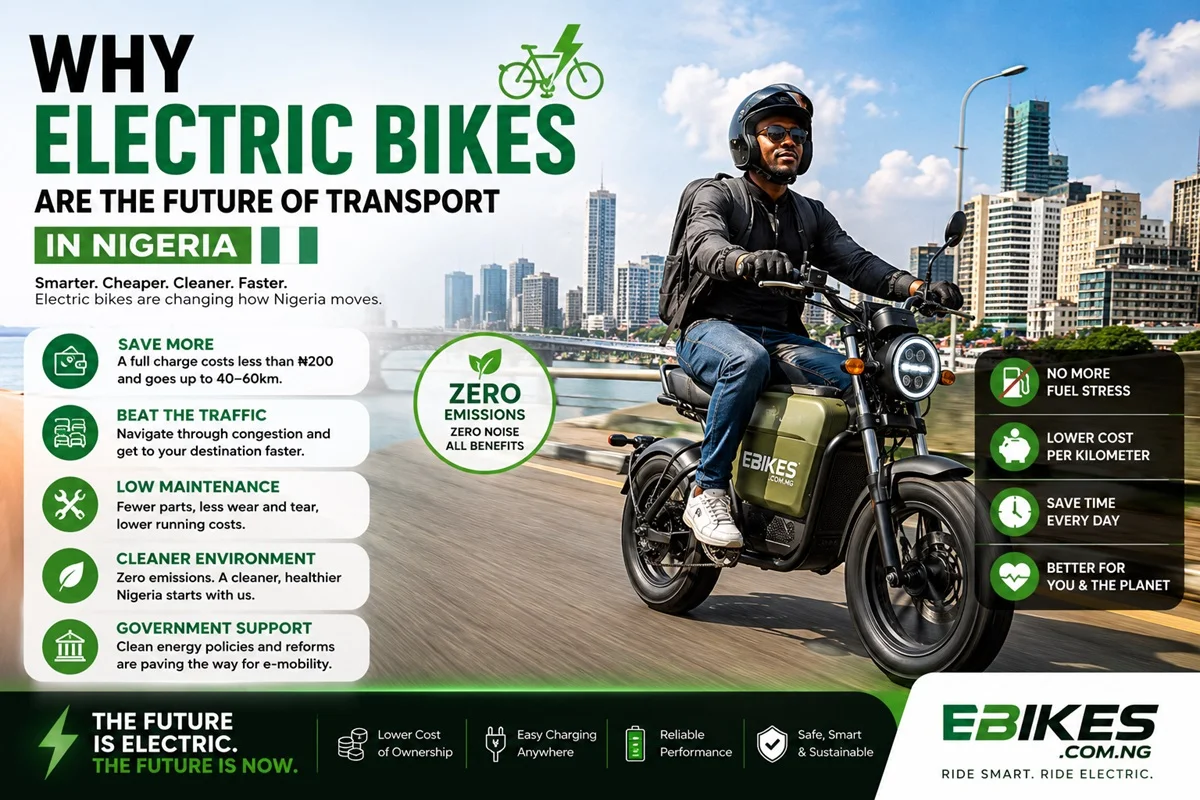
1. Rising Fuel Costs Are Putting Pressure on Commuters
Fuel is one of the biggest recurring expenses for Nigerians who rely on petrol-powered vehicles.
Every trip comes with a fuel cost, and frequent commuters can spend a significant portion of their income simply getting to and from work.
An e-bike changes that equation.
Instead of repeatedly buying petrol, you recharge a battery. Depending on the battery capacity, electricity tariff, charger efficiency, riding conditions, and distance travelled, a single charge of 40 to 60KM ride can cost at most 1 unit of electricity unit which is up to ₦250.00 for the top tier electricity tariff and that's substantially less than the equivalent petrol for personal car or public fares required to cover the same journey.
For many urban riders, that can translate into meaningful savings over time. Less spent on energy or fares means more money kept in your pocket.
2. Traffic Is Only Getting Worse
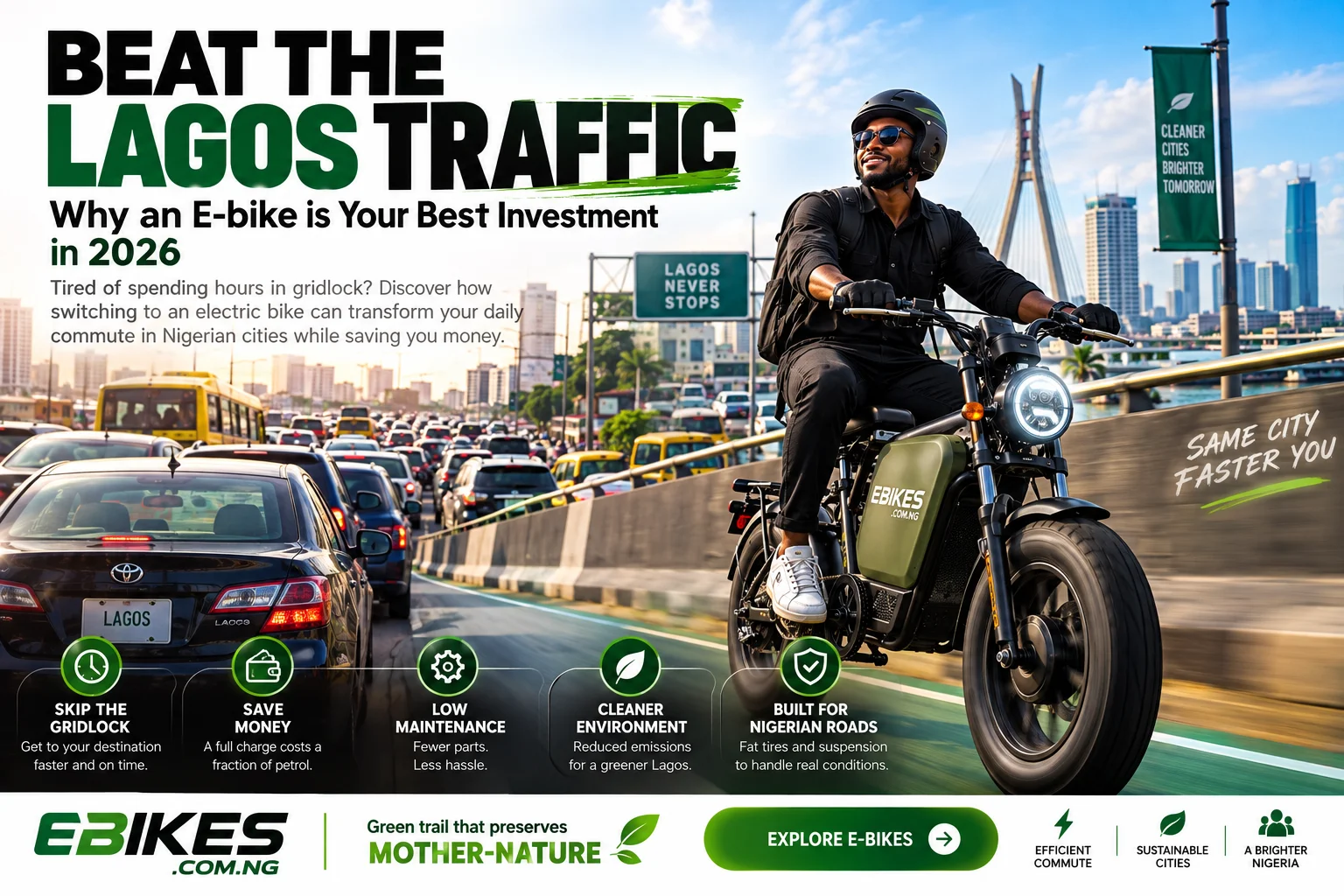
Anyone who regularly travels through Lagos, Abuja, Port Harcourt, or other major Nigerian cities knows how quickly a short journey can turn into hours on the road.
Traffic congestion doesn't just waste time. It also means more fuel consumed while vehicles crawl through traffic.
E-bikes offer a different approach.
Their compact size makes them particularly practical for navigating dense urban environments, while their electric powertrain eliminates the need to idle a petrol engine in traffic.
For short and medium-distance journeys, an e-bike can provide a faster, simpler alternative to sitting in congested traffic. Your time is valuable. Your commute shouldn't consume it.
3. Maintenance Can Be Significantly Simpler
Petrol-powered vehicles have complex mechanical systems that require regular servicing.
E-bikes have considerably fewer components associated with propulsion.
There is no engine oil to change, no spark plugs, no fuel injectors, and no conventional petrol engine requiring routine servicing.
Instead, maintenance generally focuses on components such as:
- Tires and tubes
- Brake pads
- Chain and drivetrain components
- Electrical connections
- Battery condition
Motor and controller systems
With proper care, this simpler mechanical architecture can make routine ownership easier and potentially less expensive. Less mechanical complexity can mean less maintenance stress.
4. The Environment Demands a Cleaner Alternative
Nigeria's transportation system remains heavily dependent on fossil fuels, while petrol and diesel generators also play a major role in everyday energy use.
Electric mobility provides an opportunity to reduce dependence on combustion engines for everyday journeys.
An e-bike produces no tailpipe emissions while being ridden.
And when charged using increasingly available renewable-energy solutions such as solar power, its environmental advantage can become even more significant.
For an individual commuter, choosing an e-bike may seem like a small decision but when thousands—or eventually millions—of journeys shift from combustion engines to electric mobility, the collective impact can become substantial. Cleaner transportation starts with individual choices.
5. Nigeria's Energy and Mobility Landscape Is Evolving
Nigeria's transition toward electric mobility is still developing, but the direction is becoming increasingly clear. Government initiatives around renewable energy, energy access, and electric mobility are helping create an environment in which electric vehicles can become increasingly relevant to everyday transportation.
At the same time, improvements in battery technology, charging solutions, solar power, and electric vehicle infrastructure are making electric transportation more practical.
The transition will not happen overnight but the foundations are being laid today. The future isn't coming, it's already moving, the question is no longer simply whether electric bikes can become part of Nigeria's transportation future, the more important question is: How quickly will Nigerians embrace them?
For commuters looking to reduce transportation costs, avoid unnecessary time in traffic, simplify maintenance, and move toward cleaner mobility, the answer may already be here. The future of transportation is electric and in Nigeria, that future is already moving. ⚡🚲🇳🇬

![Electric Bikes vs Okada in Nigeria: Which Is Cheaper? [Real Cost Comparison]](https://yceztqytlxududahwexm.supabase.co/storage/v1/object/public/site-assets/blog/1787574307586-cdjubrf98ir.webp)